Search This Blog

Monday, 27 May 2013

Stay out of danger

Safety is #1

If you feel like you are in an unsafe situation with your horse, you need to get out of the situation immediately to a place where you are safe and not try to be 'the hero' or 'beat' the horse. Clinton Anderson puts it nicely when he says, "there are plenty of heroes in the graveyard".

When you are out of potential danger, then you can re-assess the situation and decide on a course of action. It may be that it is ok to get back on, maybe you need to phone a friend, or just maybe you need to put the horse to work to convince him that what he did was a bad idea.

What ever the reason and decision you reach, just make sure you do your thinking AWAY from the danger zone.

Being able to do this seemingly simple thing, is one many horse owners struggle to do. I certainly remember when I was younger; I had to 'show the horse who was boss!' Experience though has taught me that it really is NOT worth it!!!


Saturday, 25 May 2013

Horses that Freak Out: On the Ground

Scary objects: On the ground

If your horse is afraid, listen to him and help him become more confident!

When your horse is 'freaking out' he is not being silly or doing it on purpose. He is actually doing what horses are SUPPOSED to do, it is an instinct that has kept their species alive for centuries. If they sense danger, their innate responses kick in and tell them to get to safety- even if in our eyes we know a plastic bag or tarpaulin will not kill them!

Unfortunately too many times I see people PUNISHING their horses for this, they whack them, yell at them and haul on their mouths, when in reality it is the persons responsibility to better prepare their horses for the many situations we subject them to. Prime example; a rider is warming up in the practice ring for a show, ALL of a sudden a balloon flies past…. the horse FREAKS out, spins around to get to safety and dumps his rider accidentally in the process. The rider hops up angry, embarrassed and disappointed, in their frustration they yank the horse in the mouth and yell at him like he should have known better. My question to these people is… "what have you done prior to this day to help your horse become more confident with spooky objects?"

Thankfully horses can be taught to not rely so heavily on this instinct. It is done through a process called desensitisation. So if your horse is afraid of something, it is your job as his leader to help him over come his fears.

Desensitisation is taught to the horse through a method called 'pressure and release'. It is important to note during desensitisation that the horse learns from the RELEASE OF PRESSURE, not the pressure itself. This is because horses seek comfort, so when the pressure is taken away they feel comfort (release). As such it is CRUCIAL that you release the pressure ONLY when the horse has shown you a sign of relaxing AND they have their feet STILL (and have committed to standing still). If you quit the pressure before he has relaxed, YOU are in effect teaching him that if he freaks out he makes the scary thing go away.

Signs of relaxing include:
-Cocking a hind leg
-Lowering his head
-Blinking
-Yawning
-Licking and chewing
-Sighing
-Blowing snot out his nose
-Being able to stand still for 15 seconds

Scenario Examples
Good: A person is rubbing their horse over with a plastic bag (pressure). After about 10 seconds the horse shows a sign of relaxing while standing still, so the handler takes the bag off the horse and stands still and relaxed (release of pressure). In this situation the horse has been positively reinforced for learning to deal better with the plastic bag
Bad: A person is nervously rubbing their horse over with a plastic bag (pressure), the horse continues to move around and cannot stand still, so the person takes the bag off anyway (release of pressure). In this situation the release of the pressure has further reinforced to the horse that freaking out is the best thing to do.

Tips to effectively teach:
-You may not be able to touch your horse right away so just desensitise the air
-Get him confident with one spooky object, then use the same method for another spooky object.
-Stay calm yourself
-Be CONSISTENT
-Make sure his feet are definitely still
-Do not release the pressure when the horse has not calmed down!
-The same principle can be applied in the saddle (see tomorrows post!)

Common spooky objects include:
-Saddle blanket
-Halter
-Bridle
-Stick
-Plastic bag
-Tarpaulin
-Ropes
-Balls
-Coloured poles
-Horse float


See this link for the Parelli's interpretation of pressure and release
Parelli's on Pressure and Release
See this link for Clinton Anderson's take on it
And one more way of thinking about it

Horses that Pull Back

How to teach a horse to tie

If your horse pulls back DO NOT tie him solid.

It is an age old belief that you teach a horse to tie, by tying him up to something unbreakable and letting him figure it out. This is NOT correct, it is also not ideal tying him to bailing twine so if he pulls back it will break, as this does not FIX the 'problem'.

Horses that do not tie up, do so because they do not understand how to appropriately respond to pressure. What this means is that they THINK when they feel pressure they need to pull away and fight it. Instead we want to teach our horses that when they feel pressure they need to do the opposite, by doing this they get 'comfort' as they are no longer being pulled on. So first off, if your horse pulls back AND doesn't lead well, he doesn't know how to appropriately respond to pressure.

It can take some time to break the habit, but it can be done, even in horses with HUGE fear issues created by tying up.

It is important to note that horses that pull back, do so because they are afraid they are trapped. By nature horses are very claustrophobic and instinctively if they feel trapped they think they must get away at once (fly from fear)!!!

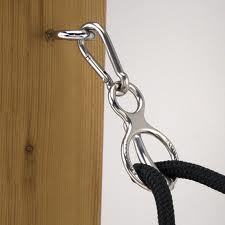
This is a complex issue to deal with at times. I do not often swear by ONE product, but in this case the Clinton Anderson Aussie Tie Ring is a must have!

http://www.youtube.com/watch?v=evul8o7AHyE
See this link for more information from the inventor himself: Clinton Anderson.


Image of the tie-ring. Available on Tack Shop website or TradeMe


Mounting your horse


Mounting your horse

If you horse moves away when you go to get on, do not get on until he is standing still.

Hopping on your horse while he is moving away reinforces the behaviour in a positive way, so he thinks that is what you want. It is unfair of us to punish him for this, as he is actually doing exactly what we taught him, by never pulling him up for it.

It can take some time at the start, but once your horse recognises what you want he will put more effort into getting it right.

To begin the new pattern of correctly being mounted:
Step 1: Stand on a mounting block, or similar object.
Step 2: Ask your horse to stand next to it, as soon as he does rub him and let him know he is good!
Step 3: Go to hop on
Step 4: If he moves away, ask him back to the correct spot INSTANTLY, any way you can, even if you have to temporarily get off the mounting block.
Step 5: Then rub him again to reward him for being in the correct spot.
Step 6: continue this process until you can mount with him standing still

Eventually he will pick rubs over moving away. It is very important he is not 'punished', rather you can make him uncomfortable for making the wrong decision of moving away.

Success Tips:
-Make sure your body language is clear- when you want him to move for not standing you should have life and energy in your body. As SOON as he stands in the right spot you should take the life OUT of your body and relax, this will help him relax too.
-You may have to ask him up to the mounting block in small increments, such as one step, rub, one more step, rub and then when he is in the perfect position give him a BIG rub
-Expect this behaviour EVERY time you mount- be consistent.
-If he walks off as soon as you get in the saddle, stop him, hop off and repeat the process.


Mounting from the fence.


This sort of thing is what I teach at lessons and during clinics! Watch this space for more handy tips!!!

Welcome

Welome to our Horse Training Tips blog!

I love learning and sharing my current knowledge!

I hope you will find the tips on this blog useful. Remember that there are MANY ways concepts can be taught to horses and these are just my thoughts. As with most things, my thoughts may change depending on the horses I work with. I feel it is important to have AS MANY training ideas as possible, so try not to instantly disregard things. Rather I think to myself, I can see the concept, maybe I will find that more relevant with a different type of horse.

I welcome thoughts and suggestions and value conversations around philosophies about horse training.